We use cookies to make your experience better.
To comply with the new e-Privacy directive, you agree to the privacy policy and our use of cookies


EPOS System for Retail Shop: A Complete Guide for UK Retailers
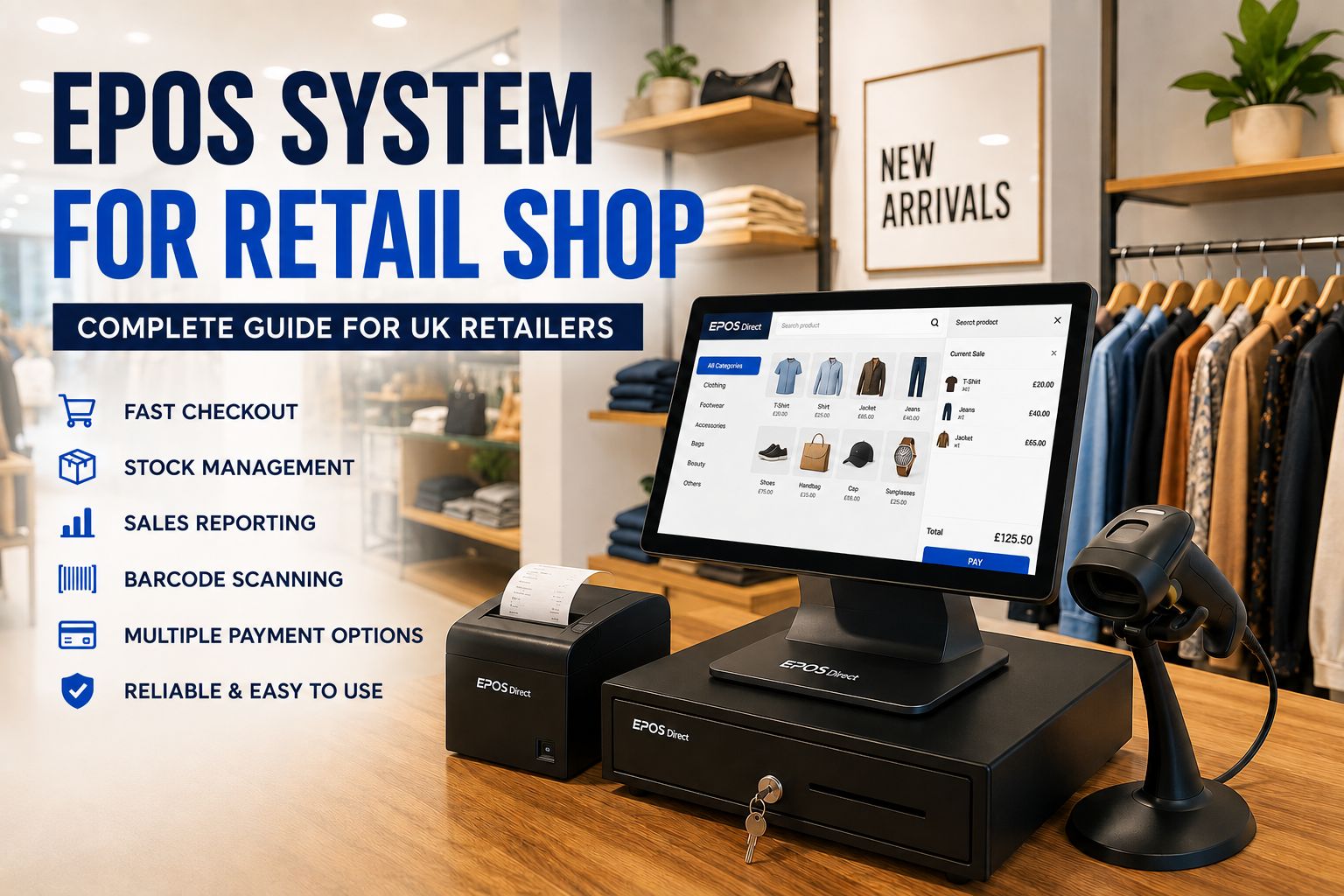
Running a retail shop involves much more than taking payments. You need to keep track of stock, process sales quickly, manage products, understand what is selling and make sure your customers have a smooth experience at the checkout.
That is where an EPOS system for retail shop businesses can make a significant difference.
An Electronic Point of Sale (EPOS) system combines your till, payment process, product information, stock management and sales reporting in one system. Instead of relying on a traditional cash register and separate spreadsheets, a modern retail shop POS system gives you better visibility over your day-to-day operations.
For UK retailers, choosing the right system is particularly important. Whether you operate a convenience store, clothing shop, gift shop, electronics retailer, footwear store or another type of retail business, your EPOS system should suit the way you actually sell.
At EPOS Direct, we help UK businesses find practical EPOS solutions designed around their retail requirements.
What Is an EPOS System for a Retail Shop?
An EPOS system for a retail shop is a combination of hardware and software used to process customer transactions and manage important retail operations.
A typical system can include:
- Touchscreen till or POS terminal
- EPOS software
- Barcode scanner
- Receipt or thermal printer
- Cash drawer
- Card payment integration
- Product and inventory management
- Sales reporting
- Staff management
- Customer information
- Returns and refunds management
The exact features vary between providers and systems, so retailers should consider what they actually need rather than paying for features they will never use.
A good POS for retail shop operations should make selling easier while giving the owner or manager useful information about the business.
Why Do Retail Shops Need an EPOS System?
A traditional till can process a basic transaction, but modern retail businesses need more information than simply knowing how much money was taken during the day.
A retail shop POS system can connect sales with products and stock, helping you understand what is happening across the business.
For example, when a customer purchases an item, the system can record the transaction and, depending on the setup, automatically update stock levels. This means you can spend less time manually checking spreadsheets and more time serving customers.
Faster Checkout
Long queues can create a poor customer experience, particularly during busy periods.
A touchscreen pos machine for retail shop use can make it easier for staff to find products, apply discounts and complete transactions efficiently.
When combined with a barcode scanner and integrated payments, the checkout process can become considerably quicker.
Better Stock Visibility
Stock management is one of the biggest challenges for many retailers.
A suitable pos software for retail shop can help you monitor stock levels and identify products that are selling quickly or approaching low-stock levels.
This can help retailers make more informed purchasing decisions and reduce the risk of running out of popular products.
More Accurate Sales Reporting
Retail owners need to know which products are generating sales.
An EPOS system can provide reports covering areas such as:
- Daily and monthly sales
- Product performance
- Transaction values
- Payment methods
- Staff sales
- Discounts
- Returns
- Best-selling products
Instead of relying entirely on manual calculations, you can use sales information to support everyday business decisions.
What Should You Look for in the Best EPOS System for Retail Shop Businesses?
There is no single system that is the best choice for every retailer.
The best EPOS system for retail shop businesses is one that matches the size, products, payment requirements and operational needs of the individual shop.
Before choosing a system, consider the following features.
1. Easy-to-Use EPOS Software
Your staff should be able to learn the system without spending weeks on complicated training.
Look for a clear interface that makes common tasks such as searching for products, processing payments, applying discounts and handling refunds straightforward.
2. Barcode System for Retail Shop
A barcode system for retail shop businesses can significantly speed up the checkout process.
Instead of manually searching for every product, staff can scan the barcode and retrieve the relevant product information.
For shops with hundreds or thousands of products, barcode scanning can save considerable time and reduce manual entry errors.
3. Integrated Card Payments
Customers increasingly expect convenient payment options.
Your retail EPOS setup should work with suitable card payment solutions and support the payment methods your customers commonly use.
Before purchasing, check which payment providers are compatible with the system.
4. Stock Management
If you sell physical products, stock management should be a major consideration.
Your retail shop software should ideally help you understand:
- Current stock levels
- Products sold
- Fast-moving items
- Low-stock products
- Product variations
- Stock movements
Better stock visibility can make ordering and inventory management much easier.
5. Sales Reporting
A good reporting system allows you to move beyond simply knowing your total sales.
You should be able to identify trends and understand which products, periods or sales channels are performing best.
This information can help you make more informed decisions about purchasing, promotions and pricing.
6. Reliable Hardware
The software is only one part of an EPOS setup.
Your pos machine for retail shop requirements may include a touchscreen terminal, receipt printer, cash drawer and barcode scanner.
Retail hardware needs to withstand regular daily use, so reliability should be considered alongside price.
EPOS System vs Traditional Till: What's the Difference?
A traditional till is primarily designed to record transactions and calculate totals.
An EPOS system goes further.
Traditional Till | Modern Retail EPOS |
Basic transaction processing | Complete sales management |
Limited reporting | Detailed sales reports |
Manual stock tracking | Integrated stock management |
Basic product information | Product database |
Limited business insights | Sales and product analytics |
Separate systems often required | Multiple functions in one system |
For a small shop with very basic requirements, a traditional till may appear sufficient.
However, as product ranges and transaction volumes increase, an EPOS system can provide much greater visibility and control.
How Much Does an EPOS System for Retail Shop Cost in the UK?
The cost of an EPOS system for retail shop businesses depends on the hardware, software, features, installation and payment integration you choose.
Some providers operate on monthly subscription models, while others offer software that can be purchased outright.
The overall cost may include:
- EPOS software
- Touchscreen terminal
- Barcode scanner
- Receipt printer
- Cash drawer
- Installation
- Staff training
- Payment integration
- Ongoing support
Don't compare systems purely on the initial price.
A cheaper system may become more expensive over time if it requires ongoing software subscriptions or additional charges for features you need.
Consider an EPOS System With No Monthly Fee
For retailers looking to control ongoing costs, an EPOS system no monthly fee model can be attractive.
EPOS Direct offers retail EPOS options designed for businesses that prefer an outright software purchase rather than being tied to recurring monthly software fees.
However, retailers should always check exactly what is included in the package and whether any separate costs apply for hardware, support, payment processing or optional services.
What Is a Retail POS System UK Businesses Can Use?
A Retail POS system UK retailers use should be suitable for the practical requirements of operating a shop in Britain.
That includes supporting common retail payment methods, VAT-related requirements, receipts, product management and reliable day-to-day sales processing.
UK retailers should also consider whether the provider offers local support, installation and training.
Choosing a provider that understands the UK retail market can make implementation easier, particularly for businesses moving away from a traditional till.
Can a Small Retail Shop Use an EPOS System?
Yes.
An EPOS system isn't only for large retailers.
A small independent shop can benefit from features such as barcode scanning, stock tracking and sales reporting.
For example, a small clothing shop could use its EPOS system to manage different sizes and colours, while a convenience store could use barcode scanning to process products quickly.
The key is choosing a system that fits the business rather than purchasing an unnecessarily complicated setup.
What Equipment Does a Retail Shop Need?
A typical retail EPOS setup may include several pieces of hardware.
EPOS Terminal
The main touchscreen terminal is where staff access the EPOS software and process transactions.
Barcode Scanner
A scanner allows employees to quickly scan products at checkout.
Thermal Receipt Printer
A thermal printer produces customer receipts quickly without requiring traditional ink cartridges.
Cash Drawer
A secure cash drawer provides a dedicated place for handling cash payments.
Card Payment Terminal
A card machine allows customers to pay using debit cards, credit cards and supported contactless methods.
The exact equipment required depends on the type and size of your shop.
What Types of Retail Businesses Can Use EPOS?
An EPOS system for retail shop businesses can be used across a wide range of retail sectors.
Examples include:
- Clothing shops
- Convenience stores
- Gift shops
- Electronics retailers
- Footwear shops
- Jewellery retailers
- Sports shops
- Bookshops
- Toy shops
- Health and beauty retailers
- Homeware stores
- Specialist independent retailers
Different businesses have different requirements.
A clothing retailer may need product variants for size and colour, while a convenience store may place greater importance on fast barcode scanning and high-volume transactions.
Why Choose EPOS Direct for Your Retail Shop?
Choosing an EPOS provider is about more than purchasing a till.
You need a system that works reliably during everyday trading and is straightforward for your staff to use.
EPOS Direct provides EPOS solutions for UK businesses, with options covering retail EPOS software and essential hardware.
Depending on your requirements, an EPOS setup can bring together your:
- EPOS software
- Touchscreen till
- Barcode scanner
- Receipt printer
- Cash drawer
- Payment solution
- Sales reporting
- Retail operations
The right configuration depends on your business, product range and preferred payment setup.
How to Choose the Right EPOS System for Retail Shop Businesses
Before making a decision, ask yourself these questions:
What products do I sell?
Consider whether you need product variations, barcodes, SKUs or different pricing levels.
How much stock do I manage?
If you have a large inventory, strong stock management becomes increasingly important.
How many employees use the system?
Consider staff accounts, permissions and sales tracking.
How do my customers pay?
Check compatibility with your preferred payment provider.
Do I want monthly software fees?
Compare subscription-based systems with outright purchase options.
What support is available?
Find out whether installation, training and technical support are available when needed.
These questions can help narrow down your options before investing in a retail POS system.
Frequently Asked Questions
What is the best EPOS system for retail shop businesses in the UK?
The best EPOS system for retail shop businesses depends on the retailer's size, product range, stock requirements, payment setup and budget. A good system should be easy to use, reliable and provide the features needed for everyday retail operations.
How does a retail shop POS system work?
A retail shop POS system records customer transactions and can connect sales with products, inventory, payments and reporting. When a product is sold, the system can record the transaction and, depending on its configuration, update stock information.
Can I use POS software for a retail shop without paying monthly fees?
Yes, some providers offer an outright purchase model. An EPOS system no monthly fee can help retailers avoid recurring software subscription charges, although you should check the provider's complete pricing and what is included.
Do I need a barcode system for my retail shop?
If your shop sells a significant number of products, a barcode system for retail shop operations can make checkout faster and reduce manual product entry. It can also help connect sales transactions with product and stock information.
What is the difference between EPOS and POS?
POS means Point of Sale, while EPOS means Electronic Point of Sale. In everyday retail use, the terms are often used interchangeably. Modern EPOS systems generally provide broader digital functions such as stock management, product databases and sales reporting.
Can a small shop use a POS for retail shop operations?
Yes. Small independent retailers can use POS for retail shop operations to process sales, scan products, manage stock and monitor performance. The system should be selected according to the shop's actual requirements.
What equipment is needed for an EPOS system?
A typical setup can include an EPOS terminal, touchscreen, barcode scanner, thermal receipt printer, cash drawer and card payment terminal. The exact equipment depends on your retail business.
Is an EPOS system better than a traditional till?
For many growing retailers, yes. An EPOS system can provide stock management, detailed reporting and product information in addition to processing sales. A traditional till may be sufficient for businesses with very basic requirements.
Can EPOS Direct provide a complete retail EPOS setup?
EPOS Direct offers retail EPOS solutions combining software and essential hardware. The appropriate setup depends on your shop's requirements, including products, stock, payment methods and checkout needs.
Conclusion:
The right EPOS system for retail shop operations can become an important part of your daily business.
It can help you process sales efficiently, manage products, monitor stock and understand your retail performance more clearly.
For UK retailers, the best choice isn't necessarily the system with the longest feature list. It is the system that provides the right combination of reliable hardware, practical software, stock management, barcode scanning, payment integration and useful reporting for your business.
If you're looking to replace an outdated till or set up a new retail checkout, explore the options available from EPOS Direct and choose a setup that matches the way your shop operates.
Recent Posts